



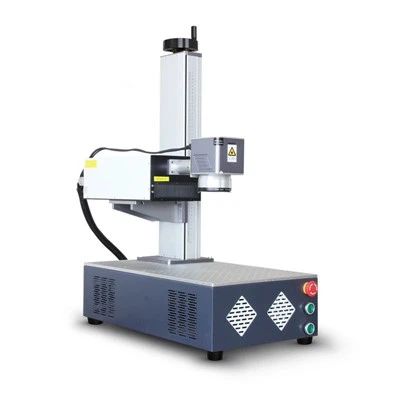
Uv Laser Marking Plastic
uv laser marking plastic

Products Description
UV Laser Marking Machines for Plastic Products
UV lasers (typically 355nm wavelength) are cold-processing. Their high-energy photons can directly break chemical bonds on the surface of plastic materials, causing delamination, discoloration, or chemical structural changes through photochemical effects rather than thermal effects. This enables high-precision, high-quality marking.Summary of Key Advantages of UV Laser Marking:Superior Mark Quality: Enables pristine, high-contrast, and permanent marks without any thermal damage to the substrate.
Material Versatility: The go-to solution for marking difficult plastics (e.g., PP, PE, PTFE) that are unsuitable for CO₂ lasers.Ultra-Fine Precision: Capable of creating incredibly detailed graphics and readable micro-text or codes that other technologies cannot achieve.
Material Integrity: The "cold" process ensures the original mechanical and chemical properties of the plastic remain unchanged, which is critical for functional and safety-critical components.UV laser marking machines for marking plastic products usually use production lines to help with batch marking of plastic products.
Products Applications
Beverage and mineral water industries, food industries (condiments, cooking oils) - PE shampoo bottles, PP shower gel bottles, PET serum bottles. Pharmaceutical industry:Products: HDPE medicine bottles, PVC medicine sheets. Chemical industry:Products: Plastic bottles for detergents and disinfectants.
Marking content
production date, shelf life, batch number, logo. Production information and safety signs are marked on the bottom or body of the bottle.
Core: Utilizes a 355nm wavelength UV laser.
Features: Cold processing mode minimizes thermal damage to the bottle body, enabling ultra-fine marking.
Automated Conveyor System:
Function: Conveys plastic bottles smoothly and evenly through the marking station.
Conveyor Belt: Typically made of food-grade or anti-static material, with adjustable width and speed.
Guardrail/Guide Bar: Ensures bottles maintain a consistent path during transport and do not stray.
Sensor: Fiber optic or photoelectric sensors are key components, detecting when bottles have reached the marking position and triggering the laser.
Integrated Control System:
Function: Connects the laser marking machine, conveyor belt, and sensors into a coordinated, integrated system.
Workflow: The sensor detects the bottle → sends a signal to the marking machine control system → the control system instructs the laser head to complete the marking in a very short time → the bottle leaves and the next one enters.


It is suitable for plastic products with more marking content. It needs to be marked on the surface of the product. The marking position is usually on the surface above the conveyor belt. The staff needs to place the product on the conveyor belt. After the product passes the sensor, the laser head will mark the content.
ABS: Very suitable. It produces clear, permanent, white or light-colored marks with high contrast. It is commonly used in electronic and appliance housings, toys, and automotive interiors.
PC (Polycarbonate): An excellent marking material. UV cold processing does not cause internal stress or microcracking, and the mark edges are sharp with no heat-affected zone. It is commonly used in medical devices, automotive headlights, transparent panels, etc.
PE (Polyethylene) / PP (Polypropylene): These polyolefin materials are generally insensitive to near-infrared lasers (such as fiber lasers), but they respond well to UV lasers. They can produce clear, foamed or color-changing marks. They are commonly used in food packaging, pharmaceutical bottle caps, and household containers.
PBT, PPS, Nylon (PA): These engineering plastics, containing benzene rings or special fillers, absorb UV light well, producing high-contrast marks. They are commonly used in precision components such as electronic connectors, gears, and bearings.
Workflow (Example)
Loading: Place the plastic workpiece onto the conveyor.
Transport: The conveyor carries the product at a constant speed.
Positioning trigger: The sensor detects the product in real time. When the product precisely reaches the bottom of the laser head, it instantly sends a trigger signal, pausing movement.
Laser marking: The marking machine receives the signal, controls the laser to complete the marking in a very short time, and resumes conveyor movement.
Unloading: The marked product flows off the conveyor and enters the next packaging station.
Unparalleled Flexibility and Automation:
Variable Content: The software connects to a database, allowing for real-time dynamic changes in marking content (such as batch dates and unique security codes), ensuring a unique code for each item.
Product Adaptability: The laser focal length allows for processing products of varying heights, diameters, and shapes.
Seamless Integration: The system can be easily integrated into existing filling and packaging lines as a smart workstation.

UV laser Marking machine for Plastic cable Marking

UV laser marking machines can permanently mark the following information on the insulation of various cables:
Specifications: Cable model and gauge (e.g., CAT6E, 28AWG), voltage rating (e.g., 300V), and fire rating (e.g., UL94 V-0).
Certifications: Safety certification marks (e.g., UL, CE, CCC logo).
Traceability: Production date, batch number, serial number, QR code, or barcode for full quality traceability.
Branding: Manufacturer name, brand logo.
Directional marking: Marking a directional arrow on fiber optic cables indicates the direction of signal transmission.
UV laser marking machines represent a significant advancement in cable marking technology. They are particularly suitable for:
High-end cables, such as data cables, medical equipment cables, automotive wiring harnesses, and aerospace cables, require stringent marking requirements for durability and precision.
Products requiring permanent traceability, such as export products and cables for industrial equipment, require clear and legible markings throughout their lifecycle.
Manufacturers pursuing zero-consumables, environmentally friendly production: Companies seeking to reduce long-term operating costs and practice green manufacturing.
Products Specifications
|
Laser Power |
3W |
5W |
10W(Optional) |
|
Model |
HJZ-UVDB |
HJZ-UVDB |
HJZ-UVDB |
|
Max Marking Range |
110mm*110mm--300mm*300mm |
||
|
Laser Type |
UV laser source |
||
|
Laser source |
GAIN (JPT and other brand optional) |
||
|
Control Software |
BSL/EZCAD |
||
|
Cooling Mode |
Water Cooling/Air cooling |
||
|
Beam diameter |
≤ 10mm |
||
|
Working Accuracy |
±0.002MM |
||
|
Ambient temperature |
10-35℃ |
||
|
Marking Speed |
1-12000mm/s |
||
|
Repetition Frequency |
20-100KHz |
||
|
Laser Wavelength |
355nm |
||
|
Minimum Font for Marking |
0.01mm |
||
|
Working Voltage |
220V+10% 50/60 Hz |
||
|
Graphic Format Supported |
AI, PLT, DXF, BMP, Dst, Dwg, DXP |
||
|
Applicable Material |
all metal material and all non metal material |
||
|
Spare Parts Come with the Machine |
Protective glasses, Metal business card, Foot switch, Hex socket wrench, Power cord |
||
|
Optional Accessories to Purchase |
D80 Rotating Shaft/ D57 Small Chuck/2D Table (X.Y direction)/ Cutting Fixture |
||
|
Net Weight (KG)/ Gross Weight |
80KG / 100KG |
||
Advantages
Three revolutionary advantages over traditional laser machines
UV laser marking machines are ideal for plastic marking. Its high-energy photons can directly destroy the chemical bonds on the surface of plastic materials, causing the material to peel, change color or change its chemical structure through photochemical effects rather than thermal effects, thereby achieving high-precision and high-quality marking.
First, the marking effect is extremely fine and clear.
Because it is a cold process, the boundary between the laser active and inactive areas is very clear.
It can produce extremely fine text, QR codes, and logos (<0.1mm) on plastics with extremely high resolution. This is crucial for marking plastic parts for precision components, medical devices, and electronics.

Second, it has an extremely wide range of applications.
UV lasers can process nearly all types of plastics, including those that are extremely heat-sensitive:
Common plastics: ABS, PC (polycarbonate), PP (polypropylene), PE (polyethylene), etc.
Engineering plastics: PBT, PET, Nylon, PPS, etc.
Sensitive plastics: PVC (polyvinyl chloride) marking with traditional lasers produces chlorine gas, which is harmful to health, but UV cold processing can safely mark it. Flexible materials such as TPU (thermoplastic polyurethane) and silicone are also suitable.
Light-colored/white plastics, such as white ABS and PC, face difficulty creating high-contrast dark markings with traditional hot working methods. However, UV lasers, through a chemical reaction, can create clear black/gray markings without yellowing the background.

Third. High Contrast, Beautiful Marking
UV lasers react chemically with plastics, typically producing a mark with high contrast against the base color (e.g., black text on white plastic, or light text on black plastic), resulting in a highly professional and aesthetically pleasing visual effect.

Fourth. Environmentally Friendly and Safe
The cold working process produces virtually no smoke or harmful gases (compared to hot working), making it more environmentally friendly and less polluting to equipment.
Fifth. Permanent Marking, Abrasion-Resistant
The marking is applied directly to the surface of the material, offering high durability and resistance to rubbing, meeting long-term requirements for product traceability and anti-counterfeiting.

Products Package
Competitive advantage
First Layer
(Contact Protection) 0.08mm thick stretch film
(Moisture-proof and antistatic formula) 360° sealed to block moisture and dust, preventing humidity-induced rust on precision guide rails (especially for shipping to Southeast Asia).
01
Second Layer
(Cushioning Layer) 5cm bubble column array
(Not ordinary bubble film) Absorbs 70% of initial impact energy.
Passes ISTA 3A vibration testing, protecting optical lenses from high-frequency vibrations caused by shipping.
02
Third Layer
(Energy Absorption Layer) EPE anti-collision foam
(CNC engraving) Customized to fit the body contour.
Pressure distribution >85%, eliminating the risk of LCD/control panel crushing and shattering.
03
Forth Layer
(Rigid Protection) 18mm plywood crate
(Fumigation treatment + steel strap reinforcement) Compressive strength >2 tons.
Forklift puncture protection, meets EU IPPC export standards (quarantine and detention exemption).
04
Fifth Layer
Fifth Layer
(Ultimate Fixation) 304 Stainless Steel Cable Ties
(Tension-locking design) Prevents cracking or internal displacement of the box.
05

Company information


Packing

Hot Tags: uv laser marking plastic, China uv laser marking plastic manufacturers, suppliers, factory, hand held laser marking machine, desktop laser marker, uv laser marking plastic, fiber marking machine, fiber laser 50 watt, best fiber laser engraver for metal
Previous
Uv Laser Engraving MachineYou Might Also Like




Send Inquiry